
Rotator cuff problems can cause shoulder pain, weakness, disrupted sleep, and difficulty lifting or reaching with the arm. Symptoms may develop gradually from repetitive use and age-related tendon changes or begin suddenly after a fall or other injury.
With more than 20 years of orthopedic experience, Dr. Brian Cohen provides individualized rotator cuff injury treatment in Columbus, OH. He evaluates the condition of the tendons, shoulder strength, mobility, activity demands, and response to previous care before recommending nonsurgical treatment or surgery.
About the Rotator Cuff
The rotator cuff is a group of four muscles whose tendons form a covering around the head of the humerus, or upper arm bone. These muscles and tendons connect the humerus to the shoulder blade and help lift, rotate, and stabilize the arm.
A small fluid-filled sac called the bursa sits between the rotator cuff and the acromion at the top of the shoulder. It helps the tendons glide smoothly during movement but can become irritated when the surrounding tissues are inflamed or injured.

Types of Rotator Cuff Injuries
Rotator cuff pain may result from several related conditions, including:
-
Rotator cuff tendinopathy or tendinitis
-
Shoulder bursitis
-
Shoulder impingement
-
Partial-thickness rotator cuff tears
-
Full-thickness rotator cuff tears
These conditions may occur together. For example, an irritated or torn rotator cuff tendon may also inflame the nearby bursa and cause pain when the arm is raised.
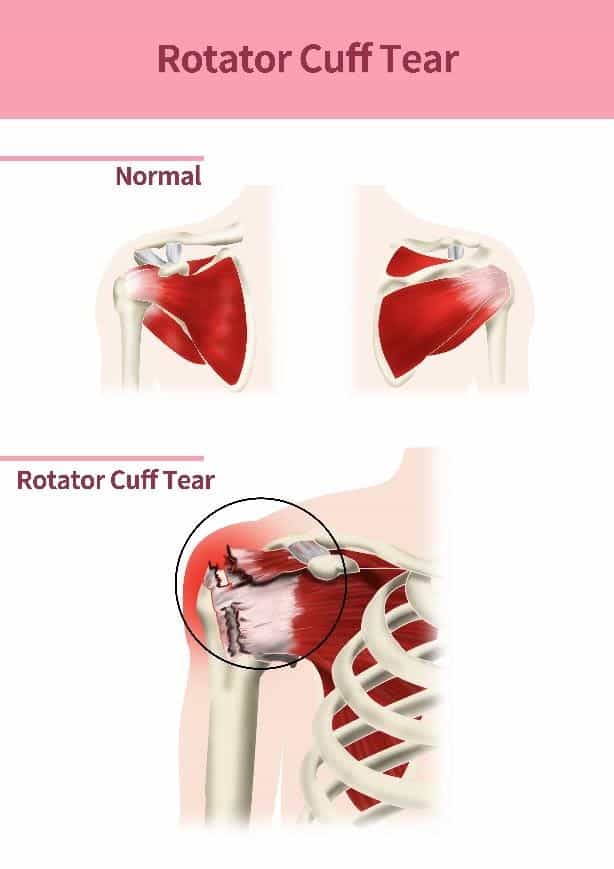
Rotator Cuff Tear
A rotator cuff tear occurs when the tendons pull away from the arm bone. A rotator cuff tear can occur as a result of an accident that tears the rotator cuff. A rotator cuff can also tear as the result of repetitive use, and can become more vulnerable as one gets older. These degenerative types of tears can be caused by bone spurs, decreased blood flow, and overuse from repetitive shoulder movements.
A rotator cuff tear may be either partial or complete. If a portion of the tendon is still attached to the bone, it is a partial tear. If the tendon is completely separated from the bone, it is a complete tear.
A rotator cuff tear can result in arm and shoulder weakness. You may find it difficult to raise your arm or hear popping/clicking sounds when moving your arm. It may also include constant pain or pain that gets worse with motion, especially if the tear is the result of an acute injury rather than a degenerative process.
Consultation and Exam
If you think you may have a torn rotator cuff, you should contact Dr. Cohen immediately. Dr. Cohen and/or one of his sports medicine colleagues will obtain a complete “history of present illness” from you and conduct a focused, comprehensive physical exam to evaluate your shoulder for areas of tenderness, assess range of motion, and establish if you have normal or decreased arm strength. Depending on the findings, the doctor may order an X-ray and/or an MRI.
Treatment Options
You can take steps to improve the health of your torn rotator cuff, but a complete tear cannot heal on its own. Nonsurgical treatment of a torn rotator cuff can include an arm sling for rest, activity modification, nonsteroidal anti-inflammatory drugs, physical therapy, and a steroid injection.
If nonsurgical treatments do not relieve the pain and return the shoulder to normal mobility, you may need surgery. One option may be minimally invasive surgery, which uses an arthroscope and small incisions to complete the procedure. This type of surgery can enable a faster recovery than traditional approaches because it is associated with less surgical trauma and has less risk of complications, including post-operative stiffness and infection.
Rotator Cuff Tendinitis
If your shoulder joint tendons and muscles are inflamed, you may have rotator cuff tendonitis.
Symptoms
If you have rotator cuff tendinitis, you may suffer from arm and shoulder weakness. You may hear popping/clicking sounds when moving your arm. You may also have pain or swelling in your arm and/or shoulder. Your symptoms will most likely get worse over time with continued activity.
If you are having pain, weakness, and loss of function in your shoulder that is unresponsive to rest, ice, and over-the-counter anti-inflammatories, you may have rotator cuff tendinitis. When symptoms do not improve with the RICE protocol (Rest Ice Compression Elevation) you should contact Dr. Cohen’s office for an evaluation by him or one of his sports medicine colleagues.
Treatment Options
Nonsurgical treatment of rotator cuff tendinitis may include rest, nonsteroidal anti-inflammatory drugs, platelet-rich plasma injections, corticosteroid injections, and physical therapy. More than 90 percent of the time, non-operative treatment is success for treating rotator cuff tendonitis; in the rare instance that it is not, a surgical procedure may be recommended. Surgery for isolated rotator cuff tendinitis is rarely required, but if an extensive course of conservative management fails, the surgery is done arthroscopically with the goal of removing inflammation and irritating factors that promote inflammation.
Rotator Cuff Bursitis
Rotator cuff bursitis is the inflammation or irritation of your bursa, a small fluid-filled sac that protects your rotator cuff.
If you are having pain, weakness, and loss of function in your shoulder that is unresponsive to rest, ice, and over-the-counter anti-inflammatories, you may have rotator cuff bursitis. Contact Dr. Cohen’s office for an evaluation by him or one of his sports medicine colleagues.
Treatment Options
Nonsurgical treatment of rotator cuff bursitis may include rest, anti-inflammatory drugs, corticosteroid injections, and physical therapy.
Surgery for isolated rotator cuff bursitis is rarely required, but if an extensive course of conservative management fails, the surgery is done arthroscopically, with the goal of removing inflammation and irritating factors that promote inflammation.
Rotator Cuff Repair with SpeedBridge™ Technique
Superior Capsular Reconstruction
Why Choose Dr. Cohen?
OVER 25+ YEARS OF EXPERIENCE
One of the first orthopedic surgeons employed by a large hospital. Dr. Cohen spent 20 years.
TRUSTED BY OVER 100,000+ PATIENTS WORLDWIDE
Over his distinguished career, Dr. Cohen has cultivated a reputation of excellence and trust among his patients and his peers.
UTILIZING THE LATEST TECHNOLOGY
To achieve the best surgical outcomes, Dr. Cohen uses the most advanced technologies and techniques, keeping his practice state-of-the-art.
PATIENT SAFETY IS TOP PRIORITY
An individualized, patient-focused process coupled with decades of training and experience helps ensure maximum safety for all of Dr. Cohen’s patients.
Rotator Cuff Injury Care in Columbus, OH
Rotator cuff pain may result from tendon irritation, bursitis, a partial tear, or a full-thickness tear. Dr. Cohen evaluates the condition of the tendons, shoulder strength, mobility, and activity needs before recommending rehabilitation, injections, arthroscopic repair, or another appropriate treatment. To schedule a consultation with Dr. Brian Cohen, call (614) 788-0375.
